
Shades and shutters handle light control. Draperies do something different: they finish a room. For Boise homeowners furnishing a new house or updating an older one, custom draperies are often the last piece added after the shades or shutters are already in place, softening the window and adding a layer of color, texture, or pattern that hard window coverings can’t provide on their own.
Why Draperies Still Matter Alongside Shades and Blinds
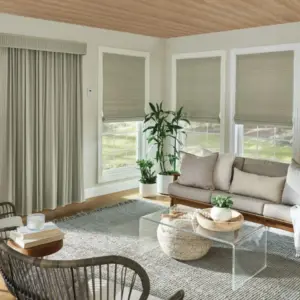
It’s a common assumption that draperies are outdated once you’ve installed a functional shade or blind, but that’s backwards. Most Boise homeowners who choose custom draperies are layering them over an existing roller shade, honeycomb shade, or set of shutters, using the drapery for framing and softness while the shade underneath handles actual light and privacy control day to day.
- Floor-length panels add height and make a room feel taller, especially useful in Boise homes with standard eight-foot ceilings
- Fabric introduces color and texture that hard treatments like blinds and shutters can’t replicate
- Draperies can be pulled fully open during the day and closed at night without affecting the shade or shutter underneath
- They soften hard surfaces like tile floors, large windows, and minimal trim
Custom-Made for Your Windows, Not a Standard Size
Off-the-shelf curtain panels are cut to a handful of standard lengths, which rarely lines up with the actual window height in a given room, especially in Boise homes with vaulted ceilings, bay windows, or taller-than-standard window openings common in newer construction. Custom draperies from Valley View Blinds are measured to your specific window and ceiling height, so panels hang at the correct length rather than pooling on the floor or stopping short.
What Gets Measured Before Ordering
| Measurement | Why It Matters |
|---|---|
| Window width and height | Determines panel width and fabric quantity needed for proper fullness |
| Ceiling to floor distance | Ensures panels hang at the correct length, whether floor-length or a custom break |
| Mount location | Confirms whether hardware mounts to the wall or the ceiling for the desired look |
Seeing Fabric in Your Own Light
Fabric color and texture change dramatically depending on the light in a room. A drapery swatch that looks warm and neutral under a showroom’s lighting can read completely differently under Boise’s strong afternoon sun coming through a west-facing window. That’s why Valley View Blinds brings physical fabric samples directly to your home during a free in-home consultation, so you’re choosing based on how the fabric actually looks in your space.
Professionally Installed and Backed for Life
Drapery hardware needs to be mounted securely, especially for floor-length panels that see daily use. Valley View Blinds installs every drapery order with its own team, and the finished installation is backed by a nontransferable lifetime warranty.
Choosing Between Functional and Decorative Draperies
Not every drapery panel is meant to open and close daily. Boise homeowners generally fall into one of two camps: those who want draperies purely as a stationary design element framing the window on either side, and those who want draperies that actually draw shut for added privacy or light control at night. Stationary panels are simpler, often narrower, and focus purely on visual framing. Functional draperies need to be sized with enough fullness to fully cover the window when closed, which changes both the fabric quantity and the hardware needed to support smooth operation.
Hardware Matters as Much as Fabric
The rod or track a drapery hangs from affects both the look and how well the panels operate over time. A decorative rod with rings suits a more traditional look and works well for panels that are drawn open and closed occasionally. A traverse rod or track system is a better fit for draperies that get opened and closed daily, since it distributes the weight and motion more evenly across the fabric. Part of the free in-home consultation includes talking through which hardware setup fits how you actually plan to use the draperies, not just how they’ll look on day one.
Pairing Draperies With an Existing Room
Because draperies are one of the more visually prominent elements in a room, Boise homeowners often start the selection process by pulling fabric ideas from existing furniture, rugs, or accent colors already in the space. Bringing physical samples into the home during the consultation makes that matching process far more accurate than trying to coordinate colors from a screen or a small mailed swatch.
Booking a Consultation That Fits Your Schedule
Valley View Blinds is available Monday through Friday from 8am to 5pm and Saturday from 9am to 2pm, giving Boise homeowners multiple options for booking a free in-home consultation. Because drapery fabric selection tends to take a bit more time than a straightforward shade or blind decision, some homeowners find it helpful to schedule the consultation early in a room’s overall design process rather than as a final step. Google reviews from other Boise customers are also available for anyone who wants a sense of what the drapery selection and installation process looks like in practice.
Draperies as the Finishing Touch
Many Boise homeowners treat draperies as the last item on a room’s window treatment list, added once a shade or shutter is already handling daily light control. Approaching the project in that order, function first with a shade or shutter, then drapery for texture and finish, tends to produce a more cohesive result than trying to solve both problems with fabric panels alone.
Frequently Asked Questions
Yes, draperies are commonly layered over an existing roller shade, honeycomb shade, or shutter, adding texture and framing while the shade underneath continues to handle daily light control.
A team member measures the actual ceiling and window height in your home during the free consultation, so panels are custom-made to hang correctly rather than relying on standard off-the-shelf lengths.
Yes, physical fabric samples are brought to your home during the free in-home consultation, letting you compare color and texture in your own lighting before ordering.
It depends on how often you plan to open and close the draperies. A decorative rod suits panels used mostly for framing, while a traverse or track system is better for draperies opened and closed daily, and this gets discussed during the free consultation.
Get Started
To bring drapery samples to your Boise home, call Valley View Blinds at (208) 908-7468 or request a free consultation.